
 By GARETT VALCOURT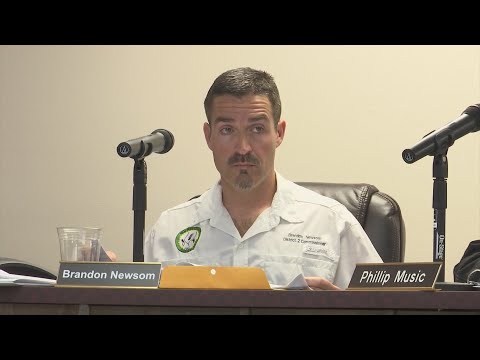
Attorneys for former Holmes County Commissioner Brandon Newsom are asking a circuit judge to grant him a new trial and allow the defense to question three jurors, alleging juror misconduct and other errors affected the proceedings that resulted in his Aug. 4 conviction.
The State Attorney’s Office is opposing the request to interview jurors, arguing the defense motion is legally insufficient and should be struck or denied.
Newsom’s attorney, Stephen G. Webster, filed both a Motion for New Trial and a 14-page Motion to Interview Jurors on Aug. 14 in Holmes County Circuit Court. The filings came 10 days after the jury returned its verdict.
Newsom was convicted Aug. 4 on two felony charges stemming from allegations connected to his activities while serving as a Holmes County commissioner and operating his private businesses.
The defense’s motion for a new trial raises three primary issues: alleged juror misconduct, limitations the court placed on the defense’s cross-examination of Holmes County Sheriff John Tate, and testimony from Whitney Milburn concerning a payment accepted on Newsom’s behalf.
However, the most extensive allegations center on the jury and the individual who ultimately served as jury foreperson.
According to the defense filing, the foreperson, identified in the publicly filed motion only by initials, had previously worked as a paramedic for Holmes County and filed a lawsuit against the Holmes County Board of County Commissioners in November 2020.
The defense alleges the lawsuit involved a whistleblower retaliation claim and asserted that the juror had been forced from county employment. The lawsuit sought damages exceeding $30,000, according to the motion.
Newsom was serving on the Holmes County Board of County Commissioners at the time the lawsuit was filed, according to the defense.
The defense contends the prospective juror did not disclose the lawsuit during jury selection despite being questioned about his familiarity and relationship with Newsom and the county commission.
According to excerpts of the jury-selection transcript included in the filing, the juror acknowledged that he had previously worked under the county commissioners and knew of Newsom but characterized his connection to Newsom as limited.
The defense argues those answers failed to reveal the extent of his previous dispute with the county.
The motion further alleges the juror did not disclose that he knew then-County Administrator David Corbin and Holmes County Human Resources Director Marti Sherrouse when their names were presented as potential witnesses.
Webster argues that had those relationships and the prior litigation been disclosed during jury selection, the defense would have sought to have the juror removed for cause or would have used one of its remaining peremptory challenges to remove him.
The filing points to several other prospective jurors who disclosed relationships with Newsom or people connected to the case and were subsequently removed for cause.
The defense also cites a sworn affidavit from Michael Edward Benton concerning an alleged conversation on the morning jury selection began.
According to the motion, Benton said he was in the second-floor lobby of the Holmes County Courthouse when he observed a man who was later selected for Newsom’s jury speaking with another man.
Benton alleges the prospective juror asked the other man what he knew about Newsom. According to the affidavit as quoted in the defense filing, the response was, “Nothing good I could say.”
The defense argues the conversation occurred before the jury was selected and after prospective jurors had been instructed not to discuss or independently seek information about the case.
The allegations contained in the defense filing have not been established as findings of fact by the court.
The defense is asking Circuit Judge Jarred Patterson to permit interviews of three jurors at an evidentiary hearing under Florida Rule of Criminal Procedure 3.575.
The motion also describes information the defense says it received after the verdict from the daughter of another juror.
According to the filing, the daughter reported that her mother said she had been the final juror holding out for an acquittal and alleged the foreperson bullied other jurors and appeared to have a vendetta against Newsom.
The daughter also allegedly reported that when a younger juror favored a not-guilty verdict, the foreperson repeatedly asserted that “the defense did not prove their case,” and that the younger juror eventually became emotional and changed his vote.
Those claims are allegations attributed to a juror’s daughter in the defense filing, rather than direct sworn testimony from the juror.
The defense acknowledges Florida law generally restricts inquiries into a jury’s deliberations and states it is not seeking a new trial based simply on the jury’s internal reasoning. Instead, Webster argues the information supports the request for juror interviews and the allegation that the foreperson may have concealed bias during jury selection.
The motion maintains that the alleged undisclosed lawsuit, employment dispute, relationships with county officials and courthouse conversation collectively establish sufficient grounds for the court to investigate possible juror misconduct.
The defense also argues the motions were timely filed within the applicable 10-day period following the Aug. 4 verdict.
The State Attorney’s Office responded by asking the court to strike Newsom’s Motion to Interview Jurors as legally insufficient.
Assistant State Attorney Megan Ford argues that Florida Rule of Criminal Procedure 3.575 establishes a significant threshold that must be met before jurors can be subjected to questioning following a verdict.
The state’s response does not necessarily address each underlying allegation on its merits. Instead, prosecutors argue the defense failed to meet procedural requirements necessary for the court to authorize juror interviews.
According to the state, although the defense motion was electronically signed by counsel, it was not verified by Newsom, his attorneys or another person and contained no declaration under penalty of perjury or oath attesting that its material factual allegations were true.
Prosecutors cite Florida case law holding that juror interviews are not permissible unless the moving party presents sworn factual allegations that, if proven true, would require a trial court to order a new trial.
The state specifically cites a July 8, 2026, decision from Florida’s First District Court of Appeal, Crawford v. State, arguing the appellate court held that a Rule 3.575 motion was legally insufficient when its allegations were unsworn.
The state also takes issue with the defense’s identification of the jurors it seeks to question.
Rule 3.575 requires a motion to state the name of any juror to be interviewed, prosecutors argue. According to the state, Newsom’s motion seeks interviews with three jurors but identifies two only as “Juror Number 2” and a “younger juror.”
Prosecutors contend that omission makes the request to interview those jurors facially deficient.
The state therefore asks the court to strike the defense motion as legally insufficient or, alternatively, deny the request on its face.
The competing filings leave several issues for the circuit court to resolve.
The defense maintains it has presented evidence sufficient to justify further investigation into whether a juror withheld material information during jury selection or was exposed to outside information before trial. The state, meanwhile, argues the court should never reach that inquiry because the motion itself fails to satisfy the procedural requirements governing post-verdict juror interviews.
A request for a new trial does not itself overturn Newsom’s convictions, and the allegations contained in the defense motions are not findings by the court.
The judge will ultimately determine whether the defense may interview any jurors and whether the arguments raised in Newsom’s separate Motion for New Trial provide sufficient grounds to disturb the jury’s Aug. 4 verdict.
 Staff Report