

 By GARETT VALCOURT
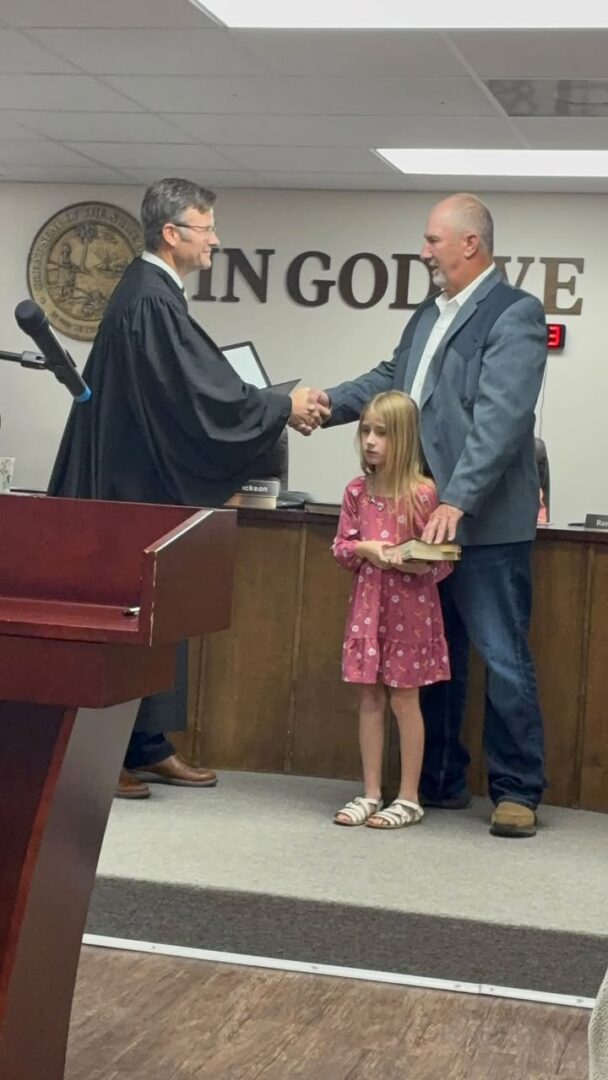
The Holmes County Board of County Commissioners welcomed two newly elected commissioners, selected its leadership and addressed a series of administrative and financial matters during its November 17 meeting, including allegations involving the use of county resources under a former commissioner, changes to public meeting schedules and appointments to economic development organizations.
The meeting marked the beginning of a new term for District 2 Commissioner Rodney Bowers and District 4 Commissioner Randon Tate, who were officially sworn into office.
Following the ceremony, commissioners unanimously elected Clint Erickson as board chairman and Wilmer Stafford as vice chairman.
The leadership transition came as commissioners considered several issues carried over from previous meetings, including county planning operations, employee vehicle policies and economic development expenditures.
One of the meeting’s most contentious discussions centered on allegations that former District 2 Commissioner Wade Ellenberg directed county employees to perform work involving limerock on a Saturday near a private driveway.
During public comment, Holmes County resident Roderick Bowers requested a formal investigation into Ellenberg’s actions, alleging that county employees and materials had been used to benefit a particular property owner at taxpayers’ expense.
Bowers questioned whether the work constituted an improper use of county resources, particularly because employees reportedly received overtime compensation.
The board did not immediately respond to the allegations during the public comment period.
However, the matter resurfaced later in the meeting when newly elected Commissioner Rodney Bowers raised similar concerns during the board’s regular business. Bowers said he received a telephone call while working Saturday informing him that county employees were transporting materials and potentially performing work on private driveways.
He said he subsequently contacted County Coordinator David Corbin to determine why employees were working overtime. According to Bowers, Corbin explained that Ellenberg had requested overtime for road maintenance, reportedly involving grading county roads. Bowers questioned whether the explanation accurately reflected the work being performed and who authorized the placement of materials.
“He didn’t tell David that. That’s not being transparent, being deceptive,” Bowers said, referring to his understanding of the work authorization.
Bowers identified the property involved as belonging to Jeremy Rolling and questioned whether county policies or ethical requirements had been violated. Chairman Erickson acknowledged inconsistencies in the county’s practices involving the distribution and placement of rock, dirt and asphalt millings.
“There is no consistency how rock, how millings, how dirt or anything is held,” Erickson said.
Erickson explained that while commissioners previously voted to discontinue certain deliveries of excess dirt to private residences, that decision did not necessarily eliminate county assistance involving driveways.
“We had voted not to haul two loads of dirt, spoiled dirt, to people’s houses,” Erickson said. “That has nothing to do with driveways … because we still help out with driveways.”
He suggested that addressing the concerns could require changes to the county’s procedures governing the distribution and use of materials.
Bowers maintained that the issue involved transparency and accountability rather than simply the county’s material distribution policies.
He subsequently made a motion requesting that County Attorney Nate Nolin investigate the circumstances surrounding the work.
The motion failed, with only Commissioners Rodney Bowers and Mitch Johnston voting in favor. The remaining commissioners opposed the investigation request.
Following the meeting, Ellenberg disputed the allegations in comments to the Holmes County Advertiser.
Ellenberg said the work involved repairing portions of county rights of way that had washed away following the installation of county improvements, rather than improving a private driveway.
He also said crews performed work at multiple rights of way that had not been mentioned during the commission’s discussion.
Ellenberg maintained that the work was intended to address county maintenance responsibilities.
No formal finding of wrongdoing was presented during the meeting, and the board did not authorize the requested investigation.
Earlier in the meeting, Erickson outlined expectations for future agenda amendments and public participation.
He reminded commissioners that the board had previously agreed to limit last-minute agenda additions to emergency matters, describing the discussion as a housekeeping measure intended to maintain consistency in meeting procedures.
Commissioners agreed to continue following that approach before approving the meeting agenda.
Erickson also announced a change in how public comments would be handled.
Under the procedure he described, residents wishing to address items appearing on the agenda would need to speak during the designated public comment period before commissioners began deliberating.
“Anything that you see on this agenda you want to talk on, you’re welcome to talk on,” Erickson said. “Once we open up the regular session for the commissioners on the agenda item, that will no longer be available, that opportunity.”
The chairman emphasized that the initial comment period would serve as the public’s opportunity to address agenda matters.
UF/IFAS Extension Holmes County representative Kalyn Waters presented proposed changes to the Holmes County Agricultural Center’s rental agreement following approximately one year of operation under its existing fee structure.
Waters said the current $500 weekend rental rate had worked well, allowing renters additional time to set up and clean up after events.
However, she suggested expanding rental options to accommodate smaller gatherings and organizations seeking more affordable access to the facility.
Among her recommendations was a weekday rental option costing $250 for five hours of use.
Waters said the shorter rental period could accommodate baby showers, graduation celebrations and other events that do not require an entire weekend.
She explained that the proposed rate was intended to help cover utilities, disposable supplies and other operational expenses. Waters also proposed an annual membership option for civic organizations that regularly hold monthly meetings. Her initial recommendation included 12 uses annually, limited to three hours per use, for $1,000.
The memberships would be nontransferable, and unused hours could not be carried over to subsequent meetings. Waters said her overall objective was to increase facility utilization while generating sufficient revenue to cover operating expenses.
Commissioner Stafford subsequently made a motion establishing a $750 annual civic organization membership and the $250 weekday rental option.
The motion passed unanimously.
Waters also briefed commissioners on the spread of an invasive pasture mealybug that has been identified in Florida.
Although the pest has primarily affected areas of South Florida, Waters said it has also been detected in neighboring Jackson County, raising concerns about its potential spread into Holmes County.
Waters said the pest poses a particular concern for local agricultural producers because of its potential impact on bahiagrass, a major forage source for livestock operations throughout the county.
She explained that roadside maintenance equipment could contribute to the spread of the invasive species if proper cleaning procedures are not followed.
Waters said she intends to coordinate with the county road department to help employees recognize potential infestations and establish appropriate reporting procedures.
She provided informational materials for road personnel and encouraged employees to contact the Extension office if they encounter suspicious vegetation.
Waters said she could assist with identification and documentation to help state officials monitor the pest’s movement.
She also said local farmers and ranchers had been informed about the issue.
While emphasizing the importance of awareness, Waters cautioned against unnecessary alarm, noting that officials are still evaluating how the species may respond to winter conditions.
Holmes County 4-H chaplain Judson Peel also addressed commissioners regarding the organization’s Meals in the Fields community service initiative.
The program, organized by Holmes County 4-H and UF/IFAS Extension Holmes County, recognizes the contributions of local farmers and ranchers by delivering meals directly to them while they work.
During the recent initiative, volunteers served nearly 60 meals to agricultural producers throughout the county. The effort included participation from homeschooled 4-H members who were available to assist while public schools were in session. Big John’s BBQ supported the initiative by providing assistance with the meals. Organizers described the program as an opportunity to express appreciation for agricultural workers whose contributions remain essential to the county’s economy and rural heritage.
Commissioners revisited a previous discussion concerning the possibility of hiring a full-time, in-house county planner.
Erickson explained that the county currently utilizes the services of planner John Feeney, whose work received positive comments from commissioners.
Despite their satisfaction with Feeney’s performance, several commissioners expressed interest in having an employee physically present in county offices to answer residents’ questions and assist with planning-related matters.
The discussion included whether the position would require a highly qualified engineer or whether a less experienced planning employee could work alongside Feeney at a lower cost.
Commissioner Rodney Bowers questioned the cost of advertising the position, with Erickson indicating that advertising expenses would be minimal.
Bowers also suggested that the county first develop a complete job description outlining the qualifications and responsibilities of the position. Commissioners agreed to direct County Coordinator David Corbin to prepare a proposed job description for consideration at the next meeting.
No hiring decision was made.
Following previous discussions about possible revisions to the county’s vehicle policy, commissioners unanimously agreed to retain the existing policy without modifications.
The decision leaves current procedures governing county vehicle use in place.
Commissioners also reconsidered the county’s membership in Opportunity Florida, a regional economic development organization.
Erickson explained that the approximately $2,000 membership expense had been eliminated during budget reductions.
However, he recommended restoring the membership, citing potential benefits involving grants, regional partnerships and economic development opportunities.
Holmes County Economic Development Commission Chairman Rickey Callahan supported the recommendation.
Callahan said the Economic Development Commission was already a member of Opportunity Florida and noted that the commission’s director was attending a rural economic development summit in Orlando.
Commissioners unanimously agreed to restore the county’s membership.
Erickson also proposed modifying the commission’s regular meeting schedule to in what he calls “an effot to reduce overtime expenses for county employees” who are required to attend evening meetings.
Erickson estimated that adjusting meeting times could save the county several thousand dollars annually. His proposal included conducting one evening workshop and one regular morning meeting each month beginning in January.
He also discussed structuring the meetings so that commissioners could conduct workshop discussions while reserving regular business and voting matters for a scheduled commission session.
Some residents expressed opposition to the proposed changes.
Nevertheless, commissioners unanimously approved moving forward with the revised meeting structure.
The change is scheduled to take effect in January 2027.
Commissioners also considered appointments involving the Rural Area of Opportunity board and the Holmes County Economic Development Commission.
The board appointed Chairman Erickson to serve on the Rural Area of Opportunity board and requested that the Economic Development Commission recommend an additional representative.
Callahan said he would bring the matter before the Economic Development Commission and return with a recommendation at a subsequent county commission meeting.
Commissioners agreed to the request.
A separate discussion involved Erickson’s recommendation to appoint YI Compete owner Scott Reid to the Holmes County Economic Development Commission. Erickson acknowledged that Reid rents a facility from the Economic Development Commission and said he had consulted County Attorney Nate Nolin about the potential conflict of interest. Nolin advised that Reid would need to abstain from voting on matters involving his rental arrangement or facility but indicated that the relationship would not otherwise necessarily prevent him from serving.
Callahan questioned why the Economic Development Commission had not been included in the appointment process. He also raised concerns about appointing a current tenant to a board that could consider matters affecting that tenant’s business.
Despite those concerns, commissioners unanimously approved Reid’s appointment to the Economic Development Commission.
Callahan additionally requested greater coordination among the county’s economic development organizations. He proposed bringing together representatives from the Economic Development Commission, County Commission, Opportunity Florida and other relevant boards to discuss economic development priorities beginning in January.
The request reflected Callahan’s interest in establishing a more coordinated approach to business recruitment, economic growth and regional development efforts.
The November 17 meeting brought several changes to county leadership and administrative procedures as newly elected commissioners began their terms.
Along with selecting board officers, commissioners approved revised Agricultural Center rental rates, restored Opportunity Florida membership, maintained the existing vehicle policy and advanced discussions concerning a potential in-house planning position.
The board also approved changes to its meeting schedule and filled an Economic Development Commission vacancy despite questions about potential conflicts of interest.
However, the failed motion to investigate allegations involving county resources highlighted differing views among commissioners regarding oversight, established maintenance practices and accountability for work authorized under previous leadership.With the new commission seated, several matters remain under consideration, including the development of a county planner job description, additional regional economic development representation and coordination among organizations responsible for promoting economic growth in Holmes County.
 AMBER PATINO
 Staff Report